
By 2025, you’ll find EVs more practical with longer ranges and faster charging thanks to advancements in battery tech. The expanding charging network means less worry about running out of power or finding a station. Improvements are also making EVs more affordable and reliable for daily use. As innovation continues, electric cars will become an even more common sight, transforming how you travel and commute. Keep exploring to discover how these changes could fit into your lifestyle.
Key Takeaways
- Battery tech advancements will offer longer ranges, faster charging, and greater reliability for daily use.
- Charging infrastructure is expanding, making long trips more feasible, but some regions still have limited stations.
- EV affordability is improving through economies of scale, making switching more accessible for consumers.
- Public engagement and cultural collaborations are increasing awareness and positive perceptions of EVs.
- Continued technological progress will make EVs more practical, appealing, and common on roads by 2025.
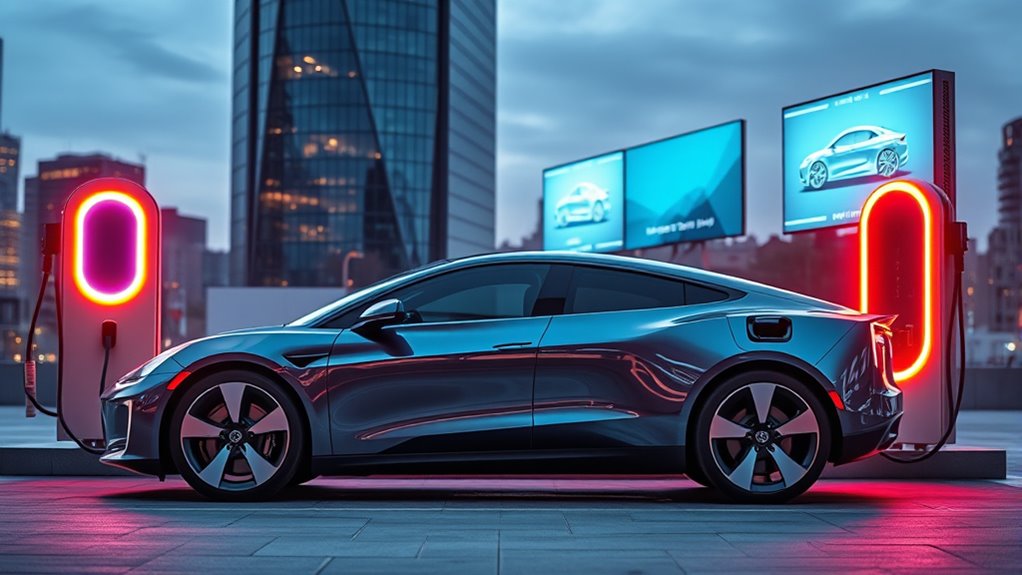
Are electric vehicles truly poised to dominate the roads by 2025? The answer depends on how quickly advancements in battery technology and charging infrastructure continue to evolve. Battery technology has improved considerably in recent years, leading to longer-lasting, more efficient power sources. Today’s batteries can store more energy, which means you’ll get a greater driving range on a single charge. This reduces range anxiety and makes EVs a practical option for everyday use, even for longer trips. Manufacturers are also working on faster-charging batteries, so your vehicle can recharge more quickly, bringing convenience closer to what you’re used to with gasoline refueling. With ongoing innovations, you’ll notice that electric vehicles are becoming more reliable and capable of matching, or even surpassing, traditional internal combustion engines. Additionally, collaborative projects with local musicians and artists are increasingly incorporated into EV branding and promotional events to boost public interest and engagement.
However, the success of widespread EV adoption by 2025 hinges on the development of charging infrastructure. While charging stations are popping up across cities and highways, they still aren’t as ubiquitous as gas stations. You’ll need to contemplate where and how often you can charge your vehicle. Fast chargers are becoming more common, and some networks are expanding rapidly, making long-distance travel more feasible. Still, in some regions, charging stations may be sparse, which could limit your options or cause delays. For EVs to truly dominate, infrastructure must be convenient, accessible, and reliable—something automakers and governments are investing heavily in. You might find yourself planning trips around charging stations initially, but as infrastructure improves, this will become less of a concern.
The combination of advanced battery technology and expanded charging infrastructure is making electric vehicles more practical and appealing. As a prospective buyer, you’ll benefit from longer ranges, quicker charges, and a more extensive charging network. These improvements mean you won’t have to worry as much about running out of power or finding a station. Electric vehicles are also becoming more affordable due to economies of scale and technological efficiencies, further encouraging adoption. By 2025, it’s likely that EVs will be more integrated into daily life, with many households replacing traditional cars. Still, staying informed about local charging options and battery capabilities can help you decide whether an EV fits your lifestyle. Ultimately, if these technological and infrastructural trends continue, you’ll see electric vehicles becoming a common sight on the roads, transforming how you commute and travel.

AIMILER Level 2 Electric Vehicle (EV) Charger(WIFI APP/Plug-play), 32A, 25ft Cable ETL Certified, 220V-240V NEMA 14-50P Plug EVSE w/ J1772 Connector, Portable EV Car Charging Stations for Home Level 2
❤ [Equipped with Nema 14-50 plug 240V, Compatible with 110-120V Nema 5-15p to 14-50r EV Adapter(Not packaged) or…
As an affiliate, we earn on qualifying purchases.
As an affiliate, we earn on qualifying purchases.
Frequently Asked Questions
How Will Charging Infrastructure Expand by 2025?
By 2025, you’ll see significant growth in charging stations, making it easier to find a place to recharge. Infrastructure expansion is underway, with more fast-charging networks and public stations popping up along highways and in cities. This means you’ll enjoy quicker, more convenient charging options, reducing range anxiety and encouraging more electric vehicle use. Expect a more seamless experience as the charging infrastructure continues to grow and improve.
What Are the Safety Features of Upcoming EV Models?
Did you know that 85% of upcoming EV models feature advanced safety features? You’ll benefit from autonomous driving capabilities that can help prevent accidents, and improved battery safety systems that reduce fire risks. These models also include collision avoidance, lane-keeping assist, and emergency braking. With these features, you can drive confidently, knowing your vehicle prioritizes safety and uses cutting-edge technology to keep you protected on the road.
Will EV Prices Decrease Significantly by 2025?
Yes, EV prices are likely to decrease considerably by 2025. Improved battery technology will lower production costs, making EVs more affordable. Additionally, increased market competition among automakers will drive prices down as they endeavor to attract more buyers. You can expect better deals and a wider range of options, making switching to electric vehicles more accessible and budget-friendly in the coming years.
How Do EVS Compare to Hybrids in Longevity?
You might find that EVs generally last longer than hybrids, thanks to fewer moving parts and less battery degradation over time. Because of their simpler design, EVs tend to have lower maintenance costs and fewer issues related to battery health. Hybrids, with their internal combustion engines, can face more wear and tear, leading to higher maintenance costs and potential longevity concerns. Overall, EVs often offer better long-term durability.
Are There Government Incentives for EV Buyers in 2025?
In 2025, you can still benefit from government rebates and tax incentives when buying an EV. Many states and federal programs offer these incentives to make electric vehicles more affordable. You should check your local regulations and available programs, as they vary by location. Taking advantage of these incentives can markedly reduce your upfront costs, making the switch to an EV more economical and appealing.
![200W Car Power Inverter, PiSFAU DC 12V to 110V AC Car Plug Adapter Outlet with [20W USB-C] /USB-Fast Charger(18W) / 4.8A Dual USB/car Charger for Laptop](https://m.media-amazon.com/images/I/41TnIJVNvzL._SL500_.jpg)
200W Car Power Inverter, PiSFAU DC 12V to 110V AC Car Plug Adapter Outlet with [20W USB-C] /USB-Fast Charger(18W) / 4.8A Dual USB/car Charger for Laptop
〖Car power inverter〗This Car power converter is equipped with 2 U.S. standard AC outlets, 4 USB charging ports,…
As an affiliate, we earn on qualifying purchases.
As an affiliate, we earn on qualifying purchases.
Conclusion
By 2025, switching to an electric vehicle is like stepping into the future with open arms. The technology is advancing rapidly, and charging stations are sprouting up like flowers in spring. Remember, doing your research now guarantees a smooth ride ahead. Embrace the change, and you’ll find yourself cruising towards a cleaner, greener tomorrow. The road to electric is wide open—are you ready to take the wheel and drive into the future?

ChargePoint HomeFlex Level 2 EV Charger J1772 – Fast Smart Battery Power Charging at Home for Electric Automobile Vehicles – Hardwired for Electric Car
Charge with Confidence: ChargePoint builds reliable, flexible EV charging stations for home, business, and fleets. Get 24/7 support…
As an affiliate, we earn on qualifying purchases.
As an affiliate, we earn on qualifying purchases.
![eAhora Romeo Pro 3 [2025 Latest] Electric Bike for Adults 50 Mph, | Peak 5600W | Dual Motor | Removable 60V 80 Ah Battery | 250 Miles Max Long Range | 26" Fat Tire | All-terrian | UL2849](https://m.media-amazon.com/images/I/51QfqH1MfPL._SL500_.jpg)
eAhora Romeo Pro 3 [2025 Latest] Electric Bike for Adults 50 Mph, | Peak 5600W | Dual Motor | Removable 60V 80 Ah Battery | 250 Miles Max Long Range | 26" Fat Tire | All-terrian | UL2849
eAhora Romeo Pro 3
As an affiliate, we earn on qualifying purchases.
As an affiliate, we earn on qualifying purchases.