
TL;DR
A Grow Organic report outlines a practical way to locate frost pockets before winter: sketch garden features, then compare minimum temperatures at crop height over several nights. Repeated readings can help gardeners prioritize tender plants for covering or harvest, but a single reading or forecast cannot establish a spot’s usual risk.
Grow Organic has published a guide to finding frost pockets before winter, advising gardeners to map slopes and sheltered areas and compare overnight minimum temperatures at crop height. The method is intended to help identify beds that repeatedly get colder, so gardeners can prioritize tender plants for protection before damaging cold arrives.

Get garden gear delivered free with Prime
- Fast, free delivery on millions of items
- Prime Video, Amazon Music and more included
- Member-only deals all year
The guide defines a frost pocket as a place where cold air collects. On clear, calm nights, the ground cools and chills nearby air; denser cold air can flow downhill and settle in low areas. A dip in the yard or a solid fence across a slope may affect that drainage. These features suggest places to investigate, but the report says gardeners should confirm suspected cold spots with measurements.
It recommends drawing a simple map of beds, slopes, walls, fences and trees, then visiting the garden early in the morning to note frost, shade and possible cold-air pools. Gardeners can compare a suspected low spot with an open bed and a potentially warmer site near a wall. The labels “frost basin” and “frost depression” are descriptive map notes, not separate scientific categories.
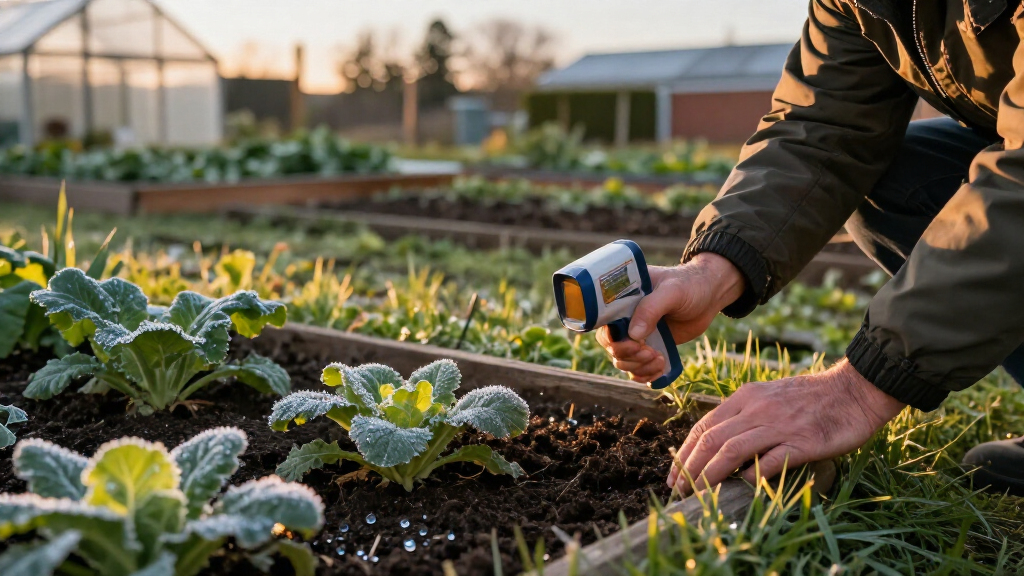
For useful comparisons, the report advises checking sensors side by side first, then placing them at matching heights near the crops, with similar ventilated radiation shields and according to the instruments’ exposure instructions. Record each site’s overnight minimum over several nights, alongside weather conditions and observed frost. Crop-height readings answer a garden-level question; they are not directly interchangeable with standard weather measurements, which are typically taken about 4 to 6.5 feet above ground.
Readings Can Guide Plant Protection
A repeated cold pattern can help gardeners decide where to cover or move tender crops first, and whether ready-to-harvest vegetables should be picked before damaging cold. The map can also help guide future planting choices. A bed that repeatedly runs colder may suit more cold-tolerant plants, while a warmer microclimate may be a better place for sensitive crops.
The practical value is in comparing locations, not assuming a particular bed will always be a fixed number of degrees colder than a forecast. Air, leaf and soil temperatures are different measurements, and one sensor cannot stand in for all of them. Keeping the setup consistent and updating the map over time gives gardeners a more useful basis for decisions than relying on one chilly morning or daytime warmth.
Protection still depends on the weather and the crop. The report mentions floating row cover as an option for suitable beds, with enough fabric to secure the edges, but it does not prescribe one cover for every plant or freeze. Gardeners should match protection to their crops and conditions and continue monitoring, including inside an unheated greenhouse, which can still freeze.
Products Worth Considering

Bose QuietComfort Ultra 2nd Generation Over-Ear Wireless Headphones with Spatial Audio, Noise Cancelling, Mic – Driftwood Sand (Limited Edit

LG StanbyME 2 Max 32-Inch 4K Portable Smart Touchscreen TV

Samsung 65-Inch Class M70H Series 4K Mini LED Smart TV (2026)
As an affiliate, we earn on qualifying purchases.
Cold Air Follows Garden Terrain
The report describes temperature inversions, when colder air sits below warmer air. Under those conditions, a garden near ground level may freeze even if a weather station reports above-freezing temperatures. Low valley areas can be colder than nearby slopes during an inversion, while higher elevations are often colder overall. A sheltered corner is not guaranteed to stay warm during a widespread cold air mass or strong winds.
Sun exposure and nearby structures can also shape small-scale conditions. In the United States, south-facing slopes generally receive more sun, while masonry can absorb heat during the day and release some after sunset. Buildings and pavement may contribute to a local heat-island effect. These are influences to record and compare, not a substitute for local readings; the guide cautions that the result depends on the local climate.
One Cold Night Is Not a Pattern
The report gives a method, not a guarantee that a specific location will freeze or that a particular cover will keep a crop safe. The number of nights needed to establish a reliable pattern is not specified; it recommends readings over several nights and across different weather conditions. Conditions can vary, so a map should be updated rather than treated as permanent.
It is also not possible to infer soil-freezing timing from the first frost alone. The source says there is no fixed interval: soil moisture, snow cover, soil depth and the duration of cold weather all affect when soil freezes. The article does not provide site-specific temperature thresholds for every crop, nor does it report independent testing of the monitoring products it names.
Keep Logging as Conditions Change
Gardeners following the guide can begin with a site sketch and a morning walk, then take consistent overnight minimum readings at the locations they want to compare. Recording dates, sensor height, cloud and wind conditions, and visible frost will help distinguish a recurring cold pocket from a single unusual night. The report recommends keeping the map and revising it each season.
After identifying colder and warmer areas, gardeners can prioritize suitable protection, move plants where practical, or harvest ready crops in line with crop-specific guidance. The guide does not set a universal date for these steps: local weather and ongoing readings remain the basis for decisions.
Key Questions
What is a garden frost pocket?
A frost pocket is an area where cold air collects, often in a low spot. Slopes, fences and nearby structures can affect how cold air moves, so a suspected pocket should be checked with readings.
How can I test whether one bed is colder?
Compare minimum temperatures at matching heights near the crops, using similarly shielded sensors. Check the sensors side by side first, then record overnight readings at each site over several nights.
Can a weather forecast tell me which garden bed will frost first?
Not reliably on its own. Garden terrain and shelter can create local differences, and the report advises against assuming a bed is always a fixed number of degrees colder than the forecast.
Does a wall always protect plants from frost?
No. A masonry wall may store daytime heat and release some after sunset, but its effect varies. Measure the site, and do not assume that shelter will protect plants during a widespread freeze.
How soon after the first frost will the ground freeze?
There is no fixed interval. Soil moisture, snow cover, soil depth and how long cold conditions last all affect when the ground freezes.
Source: groworganic.com