
TL;DR

Get garden gear delivered free with Prime
- Fast, free delivery on millions of items
- Prime Video, Amazon Music and more included
- Member-only deals all year
A Laidback Gardener report published October 3, 2026, explains that walnut trees release juglone, a compound that can inhibit some nearby plants. The article says effects depend on factors including time, soil moisture and plant species; it does not mean nothing can grow near a walnut.
A gardening report published October 3 says walnut trees release juglone, a chemical compound that can inhibit the growth of some nearby plants, but the effect varies by species and growing conditions. The Laidback Gardener article challenges the blanket claim that nothing can grow under a walnut, describing both tolerant plants and factors that may change the level of impact.
The report describes juglone as a compound found in several parts of walnut trees, including roots. It says roots release the chemical into surrounding soil through root exudation. At sufficient concentrations, juglone can disrupt cellular respiration and photosynthesis in susceptible plants, the article says. It does not provide measurements of soil concentrations or present new experimental results.
According to the article, the effects may take 10 to 15 years to become apparent around a walnut tree, and may be more severe in dry soil than in well-irrigated conditions. It identifies blueberries, cranberries and rhododendrons as particularly sensitive, while saying onions, beets and parsnips can grow under young walnuts. Blackcurrants, elderberries and grapevines are also described as relatively tolerant. The report says ginseng has shown strong tolerance, but offers no detailed trial data or growing recommendations.
The article places walnut trees within a wider discussion of allelopathy, the influence of one plant on another through chemical compounds. It notes that rice and eucalyptus are also associated with allelopathic effects, and lists oats, sunflowers, clover, garlic mustard and mustard as plants containing compounds that may have such effects. The presence of a compound alone, it cautions, does not establish that a plant will harm its neighbors in every setting.
Choosing Plants Near Walnuts
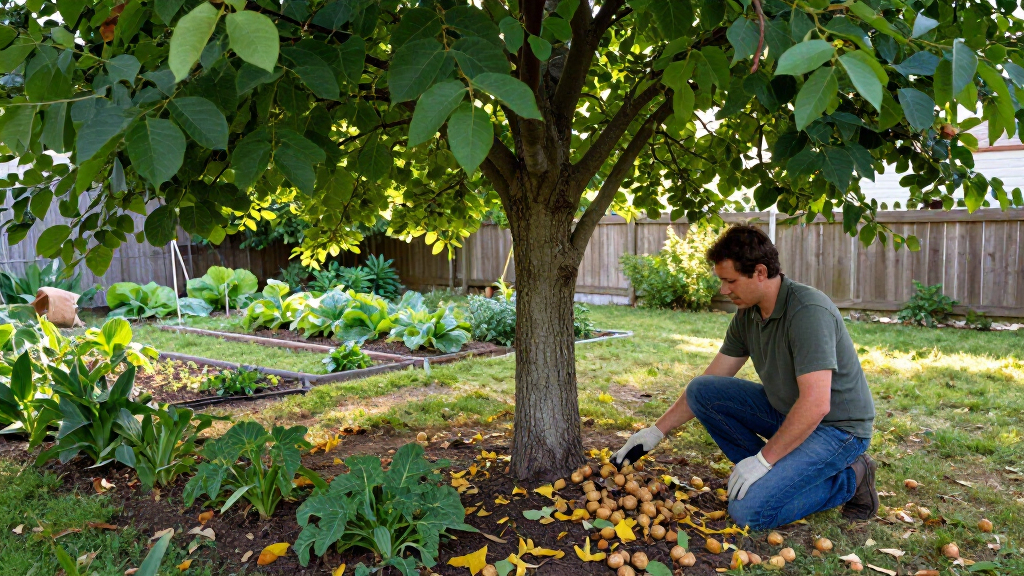
For gardeners, the practical point is that a walnut tree does not automatically make its surrounding ground unusable. Plant choice matters: a bed of juglone-sensitive shrubs may struggle, while some vegetables and other plants may tolerate the conditions described in the report. That distinction can help prevent gardeners from removing a tree or abandoning a planting area based on an absolute rule.
The report also highlights that shade and soil moisture can complicate diagnosis. As a walnut grows, reduced sunlight may weaken sun-loving plants independently of any chemical effect; dry soil may also make juglone effects more severe, according to the article. Gardeners observing decline should not assume juglone is the sole cause based on proximity alone.
Beyond home gardening, the topic has research interest. The report says some researchers are studying allelopathy for possible applications in biopesticides and in controlling invasive plants. Those are research possibilities, not established treatments or products, and the article does not identify a specific development or timeline.
As an affiliate, we earn on qualifying purchases.
How Juglone Enters Soil
The report explains allelopathy as chemical influence between plants. Botanist Hans Molisch named the phenomenon in the 1930s, according to the article, while its scientific understanding developed further in the 1980s. The term once covered both beneficial and harmful interactions, but is now commonly associated with negative effects.
For walnuts, the proposed pathway is gradual release of juglone from roots into the surrounding soil, called the rhizosphere. The article says effects emerge when concentrations reach a certain level, though it does not specify that threshold. It also distinguishes walnut effects from the bare areas sometimes found beneath eucalyptus, which it attributes to other chemical compounds rather than juglone.
“nothing grows under a walnut tree”
— Laidback Gardener report
As an affiliate, we earn on qualifying purchases.
Limits of the Garden Evidence
The report does not identify the studies behind its plant-tolerance list, quantify juglone levels, or specify how distance from a tree affects exposure. Its 10-to-15-year estimate and comparisons between dry and irrigated soil are presented without supporting data in the supplied article. Conditions may differ among walnut species, individual trees and sites.
It is also unclear how often plant decline near walnuts is caused mainly by juglone rather than shade, competition for water or other soil conditions. The article’s discussion of possible biopesticides and invasive-plant control describes areas of research, not confirmed applications. Its speculation about future medical uses is not supported with evidence in the report.
As an affiliate, we earn on qualifying purchases.
What Gardeners Can Watch
The report does not announce a new study, product or follow-up date. For now, its practical guidance is to treat walnut compatibility as plant- and site-specific, rather than assuming all species will fail. Gardeners can note which plants decline, when changes occur, and whether watering or shade may also explain the problem.
Further research would be needed to establish reliable exposure thresholds, compare walnut species and test the listed plants under controlled conditions. Until then, the report’s claims about tolerant species and possible future uses of allelopathy should be read as guidance and research prospects, not guarantees.
As an affiliate, we earn on qualifying purchases.
Key Questions
Do walnut trees prevent all plants from growing nearby?
No. The report says some plants can tolerate conditions near walnuts, while others may be sensitive to juglone. It also notes that effects depend on growing conditions.
What is juglone?
Juglone is a compound found in several parts of walnut trees. The article says roots release it into nearby soil, where sufficient concentrations can interfere with processes such as photosynthesis and cellular respiration in susceptible plants.
Which plants does the report say may tolerate walnuts?
It lists onions, beets and parsnips as options under young walnut trees, and names blackcurrants, elderberries and grapevines as relatively tolerant. It also reports that ginseng may be tolerant, without giving detailed trial results.
Which plants are described as especially sensitive?
The report names blueberries, cranberries and rhododendrons, along with apple and pear trees, as plants that may struggle near walnuts. It does not provide quantitative comparisons or guarantees for particular garden sites.
How soon can walnut effects appear?
The article says effects may take 10 to 15 years to become apparent and may be worse in dry soil. It does not provide the underlying study details, so the timing should not be treated as a fixed rule.
Source: rss
Fall Picks
fall essentials
As an affiliate, we earn on qualifying purchases.