
TL;DR

Get garden gear delivered free with Prime
- Fast, free delivery on millions of items
- Prime Video, Amazon Music and more included
- Member-only deals all year
Planet Natural’s guidance says snow-covered shrubs do not always need intervention: loose powder can usually stay, while loose wet snow may be lifted gently from a small, safely reachable shrub. Ice should be left to melt, and branches near hazards or showing serious damage call for professional help.
The report distinguishes among loose powder, heavy wet snow and ice, because each presents a different risk. A light coating on flexible branches is not automatically a reason to intervene. The article says to check the plant rather than assume it needs clearing, while avoiding unnecessary handling that could itself damage branches.
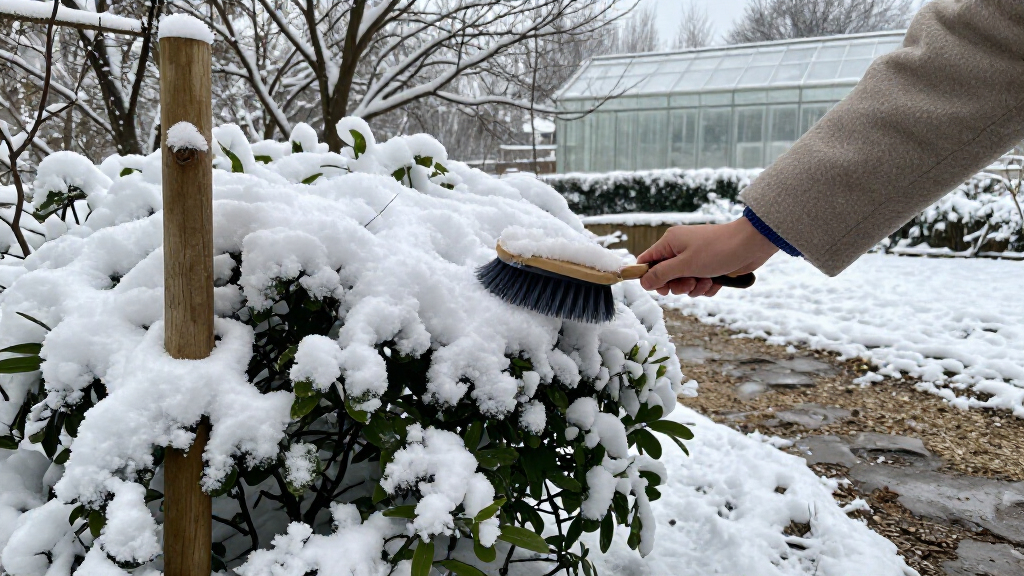
For a small shrub that can be reached safely, the report recommends using a soft broom or gloved hand to lift loose, wet snow with an upward motion. It advises against sweeping down, yanking stems or striking the plant. Stop if the snow does not release easily, the shrub creaks, or a split appears. The goal is only to remove weight that comes away without force, not to clear every branch.
Ice should be left to melt naturally, according to the report. Chipping, beating or bending ice-covered branches can break the wood; hot water and deicer should not be applied to the shrub. The guidance also cautions against forcing a bent, frozen shrub upright or tightly binding its stems. After thawing, unbroken branches may recover gradually.
Choosing the Safest Snow Response
The distinction matters because an attempt to protect a shrub can create more strain. Pulling or striking loaded branches can add force to stems already under pressure, while breaking away ice may damage the wood. Waiting is often the safer choice when the material is frozen or the plant is only temporarily bent.
The same advice sets a clear boundary for homeowners: a small shrub within safe reach is different from a plant beneath a loaded tree, beside a roof edge or near electrical wires. People and pets should stay clear of dangerous areas. The report says work near power lines belongs to the utility company and qualified professionals, not a homeowner with a broom.
Products Worth Considering

LG 75-Inch QNED73B Mini LED 4K Smart TV (2026)

Hisense 75U6SF Pro 75-Inch U6 Pro Mini-LED 4K UHD Smart Fire TV

Ring Alarm 14-Piece Wireless Security System
As an affiliate, we earn on qualifying purchases.
Snow Loads, Ice and Site Risks
Planet Natural’s report frames the issue as a question of what is weighing on the branches and whether the area is safe, not simply whether a shrub looks covered. It identifies multi-stemmed arborvitae and junipers as examples of evergreens that can spread under heavy wet snow. The article cites Iowa State guidance for upward brushing and the risk that improper removal can increase breakage.
It also distinguishes natural snowfall from snow piled during clearing. Dense shovel loads and salty slush can harm shrubs beside paths or driveways. The report recommends directing shoveled snow elsewhere, avoiding excavation through buried branches, and planning a sheltered, stable location for container evergreens before a storm rather than moving a heavy or frozen pot by its trunk.
Damage Often Shows After Thaw
The report does not give a single rule for how much snow a shrub can bear. Species, branch structure and the weight and condition of the snow differ, so the visible covering alone cannot determine whether removal is needed. A shrub that bends may be damaged, or it may recover after thawing; the article cautions against treating a single afternoon of drooping as a reason for corrective pruning.
The extent of damage may become clearer only when conditions are safe and branches have thawed. The report advises checking for splits, torn bark, broken stems and hanging limbs. It does not prescribe one pruning schedule for all plants: timing and the amount to cut depend on the species, and a conifer should not automatically receive the same cutback as a deciduous shrub.
Inspect After Conditions Improve
Once the area is safe and branches have thawed, inspect the shrub for breaks and document damage from a safe distance. The report recommends seeking prompt professional assessment for a hanging or unstable branch. Small, nonhazardous shrub damage can be pruned after the plant is evaluated and safely accessible, with the approach matched to the species.
For future storms, homeowners can note where snow accumulates and adjust storage routes, consider a suitable protective structure, or install flexible ties before winter where appropriate. Any support should not lift, twist or load frozen stems. Where safe support is not possible, leave the plant alone and seek advice rather than attempting an emergency fix.
Key Questions
Should I brush snow off every shrub?
No. Planet Natural says loose powder on flexible branches can usually be left alone. Check for unusual bending and changing snow conditions, but avoid repeated handling or trampling the planting bed just to clear it.
How should I remove wet snow from a shrub?
Only work on a small shrub that is safely reachable from stable ground. Use a soft broom or gloved hand and lift upward, removing only snow that comes away easily. Do not yank, strike or sweep downward; stop if branches creak or split.
Can I knock or melt ice off the branches?
No. The report advises letting ice melt naturally. Do not chip, beat or bend ice-covered branches, pour hot water on them, or apply deicer to the plant.
When should I call a professional?
Keep away from hanging limbs, unstable trees, roof slide hazards and branches near power lines. Contact an arborist for hazardous tree damage; power-line hazards should be handled by the utility company and qualified professionals. The report says to use emergency services when there is immediate danger.
Source: planetnatural.com